
防潮橱柜哪种材料最好?马来西亚气候实测2026 | EverGreen
09/06/2026
E0 vs E1 vs E2 Melamine Board Malaysia: Which Grade Is Safe for Your Home?
09/06/2026Plywood Kitchen Cabinet Malaysia: Honest Pros, Cons & 2026 Price Guide
If you’re researching kitchen cabinets in Malaysia and someone told you plywood is the premium choice — they’re right. But “premium” doesn’t automatically mean “right for you.” This guide cuts through the marketing and gives you the actual data: what plywood kitchen cabinets in Malaysia are genuinely better at, where they fall short, and whether the price difference makes sense for your situation.


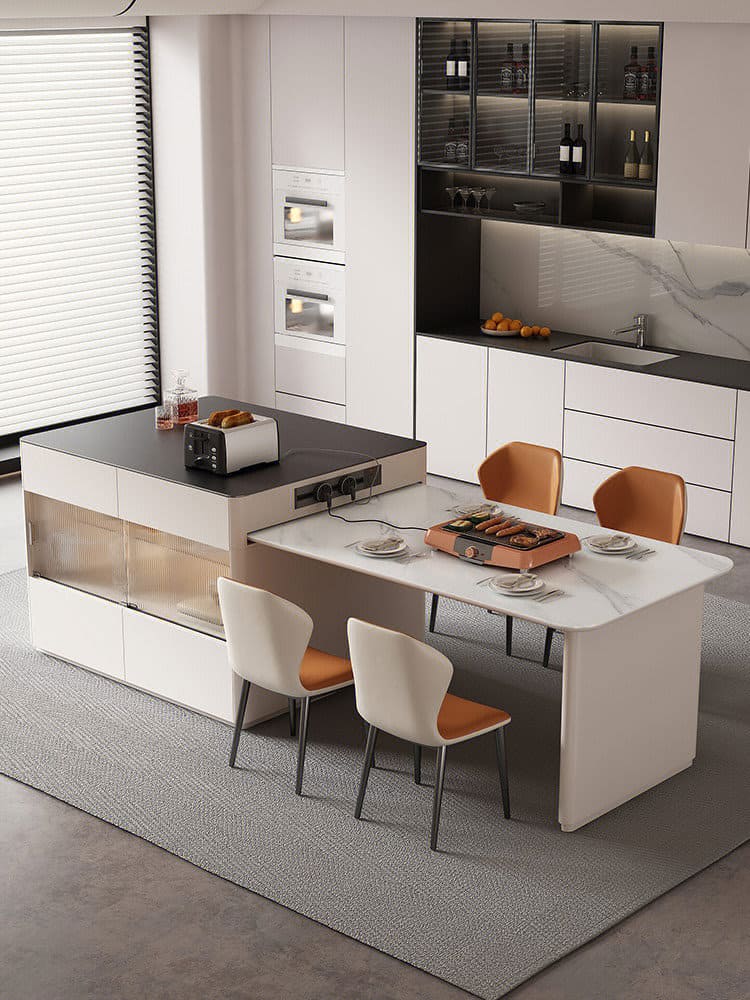
Plywood Kitchen Cabinet Malaysia: What Makes Plywood Different?
How It’s Made (Cross-Laminated Layers)
Plywood is built from thin wood veneers (plies) stacked in alternating grain directions and bonded under heat and pressure. The cross-grain construction is the key structural feature: each layer counteracts the movement tendencies of the one above and below it, creating a panel that resists warping and splitting far better than panels made from wood particles.
A standard 18mm kitchen cabinet plywood panel typically has 9–13 plies, depending on veneer thickness. More plies generally means more dimensional stability.
Why That Matters in Malaysian Humidity
Malaysia averages 75%–90% relative humidity year-round, with kitchen humidity spiking much higher during cooking. Wood-based panels absorb atmospheric moisture, and the resulting expansion-contraction cycle is what degrades most cabinet materials over time.
The cross-laminated structure of plywood means this moisture movement is distributed and counterbalanced across layers — instead of a panel swelling in one direction and delaminating, it absorbs and releases moisture more evenly. This translates directly to a longer lifespan in Malaysian conditions.
Plywood Kitchen Cabinet Malaysia: Pros — The Real Ones
Moisture Resistance vs Particleboard
This is where the gap is most significant. Particleboard (the most common budget alternative) is made from wood chips and shavings bound with adhesive — a structure that absorbs water quickly and loses integrity when wet.
Conduct a simple soak test: submerge both materials for 24 hours. Particleboard swells 10%–30% and starts delaminating at the edges; plywood warps slightly but recovers when dried. In a Malaysian wet kitchen that regularly hits 85%+ humidity, this difference plays out over years of daily cooking.
The practical result: properly sealed plywood kitchen cabinets in Malaysia routinely last 15–20 years. Particleboard cabinets in the same wet kitchen environment typically begin showing visible damage — swollen base panels, peeling edges — within 5–7 years.
Load-Bearing Over 10 Years
A lower cabinet needs to support woks, rice cookers, pots, and food stocks. The cumulative weight isn’t trivial, and under sustained load, particleboard shelving deflects (sags) measurably within 2–3 years.
Plywood’s cross-grain construction gives it roughly 40% better load-bearing capacity at equivalent thickness. In practical terms, an 18mm plywood shelf spanning 900mm with 30kg of contents shows minimal deflection after a year; the same-dimension particleboard shelf shows visible sag in under 12 months.
Screw-Holding Strength (Hinges and Handles)
This is an underappreciated advantage. Cabinet hinges and handle hardware rely on screw-holding strength — the ability of a panel to grip a screw thread without spinning out or pulling through.
Plywood holds screws significantly better than particleboard, especially at the edges. If you’ve ever had a cabinet hinge become loose and wobbly within a few years, it was almost certainly in a particleboard carcass. In a plywood carcass, the same hinge location stays tight for the cabinet’s full lifespan.
E0 Certification Availability
Plywood formaldehyde emissions depend entirely on the adhesive used in manufacture — not the wood itself. E0-grade plywood (≤0.5mg/L formaldehyde) is widely available in Malaysia and is the grade EverGreen uses as standard.
For families in Klang Valley condos with limited kitchen ventilation — which applies to a large proportion of urban Malaysian homes — E0 certification isn’t a premium option, it’s a meaningful health baseline. Learn more in our E0 board Malaysia guide.
Plywood Kitchen Cabinet Malaysia: Cons (Being Honest)
Upfront Cost Premium
Plywood kitchen cabinets in Malaysia cost approximately 20%–40% more than equivalent particleboard options. For a standard Malaysian terrace house kitchen (approximately 10 linear feet of lower and upper cabinets), this translates to a price difference of roughly RM 2,000–4,000.
That’s a real number that matters when you’re allocating a renovation budget across multiple items — flooring, tiles, appliances, and cabinets all competing for the same pool of money.
The counterargument is the 10-year cost calculation: if particleboard cabinets need replacing or significant repair at the 6–8 year mark, and renovation costs have increased by then, the initial premium for plywood looks different. But this is a personal judgment call that depends on your timeline and budget reality.
Surface Finish Limitations
Plywood’s edge cross-section — the exposed layers visible when a panel is cut — is visually coarser than MDF’s smooth, uniform edge. For door panels where the edge is visible (open-grain door profiles, certain carved designs), MDF gives a cleaner finish.
This is why some manufacturers use plywood for cabinet carcasses but MDF for door panels — a hybrid approach that optimises for both moisture resistance (carcass) and paintability/carving detail (doors). It’s a completely valid approach. The key is knowing what material each component is made from.
Good cabinet edge treatment (ABS or PVC edgebanding, properly heat-pressed) minimises this visually on carcass panels where the cross-section might otherwise show.
Plywood vs Particleboard vs MDF vs Aluminium
| Material | Moisture Resistance | Load Bearing | Price RM/ft (carcass) | Lifespan (Malaysia) | Best For |
|---|---|---|---|---|---|
| Plywood E0 (18mm) | ★★★★★ | ★★★★★ | RM 350–500 | 15–20 years | Wet kitchens, all base cabinets |
| Particleboard (18mm) | ★★☆☆☆ | ★★★☆☆ | RM 200–280 | 5–8 years | Dry storage, budget priority |
| MDF Moisture-Resistant | ★★★☆☆ | ★★★☆☆ | RM 280–380 | 10–15 years (dry only) | Door panels, dry kitchen |
| Aluminium Frame | ★★★★★ | ★★★★★ | RM 500–700 | 20+ years | Extreme wet zones, commercial |
Which Kitchens Should Definitely Use Plywood?
Wet Kitchens (Malaysian Standard)
Most Malaysian terrace houses and semi-Ds have a wet kitchen — a separate cooking area with an open flame, high heat, and significant steam. The combination of cooking moisture and Malaysia’s ambient humidity is uniquely demanding on cabinet materials. Plywood is the only wood-based option that holds up reliably in this environment.
Base Cabinets Near Sink
The under-sink cabinet is the highest-risk location in any kitchen — plumbing leaks, dish-washing splash, and condensation from cold water pipes all target this area. Regardless of what material you use elsewhere, the under-sink cabinet carcass should always be plywood.
Full-Height Pantry / Larder Cabinets
A full-height pantry takes concentrated, sustained weight — canned goods, appliances stored on shelves, bottles. The load-bearing advantage of plywood matters significantly here, especially for shelf spans over 600mm.
2026 Plywood Kitchen Cabinet Price in Malaysia
The following prices reflect the Klang Valley market in 2026. They cover carcass material, Melamine or PET door panels, and basic hardware (standard hinges, door handles). They do not include installation.
| Specification | Carcass Material | Reference Price (RM/linear ft) |
|---|---|---|
| Basic (standard plywood + Melamine doors) | F-grade plywood | RM 280–350 |
| Standard (E1 plywood + Melamine/PET doors) | E1 certified | RM 320–420 |
| Quality (E0 plywood + HPL/UV doors) | E0 certified | RM 380–500 |
| EverGreen Standard (E0 + imported hardware + 3D design) | E0 certified | RM 420–550 |
A full kitchen renovation (lower cabinets + upper cabinets + countertop, excluding appliances) for a typical Malaysian terrace house kitchen runs RM 15,000–35,000 depending on material tier, kitchen size, and design complexity.
How to Verify Your Contractor Is Using Real Plywood
This is an important practical point: particleboard and plywood can look identical once the surface material is applied. Here’s how to check before you sign off:
Ask for the material specification sheet. A legitimate contractor should be able to provide a spec sheet naming the exact board used (brand, thickness, E-grade).
Check the cut edges during installation. Plywood shows visible layers (plies) at any cut edge. Particleboard shows compressed wood particles — a more uniform, granular texture. If you can look at an unfinished edge during installation, the difference is unmistakable.
Ask about the thickness. Plywood cabinet carcasses should be 18mm for lower cabinets and pantries. 15mm is acceptable for upper cabinets. If a contractor quotes significantly lower than market price, ask specifically what board thickness they’re using.
Request the delivery documents. Board deliveries typically come with a delivery order that notes the material type. A transparent contractor won’t hesitate to show you this.
FAQ
Q1: Is plywood worth the extra cost for Malaysian kitchens?
For wet kitchens and base cabinets near the sink, yes — the lifespan difference compared to particleboard in Malaysian humidity conditions is substantial (15–20 years vs 5–8 years). For dry storage areas in better-ventilated spaces, the case is less clear-cut.
Q2: What is the price of plywood kitchen cabinets in Malaysia in 2026?
E0-grade plywood carcass with PET doors runs approximately RM 380–500 per linear foot in the Klang Valley market. A standard kitchen (10 linear feet, lower and upper combined) would range from RM 12,000–18,000 in the mid-tier, excluding installation and countertop.
Q3: Can I use plywood for upper cabinets and particleboard for lower cabinets?
Not recommended. Lower cabinets bear more weight and are closer to moisture sources (sink, floor). If you’re going to use plywood anywhere, it should be the lower cabinet carcasses first.
Q4: What is the difference between E0 and E1 plywood?
Both ratings refer to formaldehyde emission levels: E0 (≤0.5 mg/L) and E1 (≤1.5 mg/L). E0 is the lower-emission option and is recommended for homes with young children, pregnant women, or poorly ventilated spaces. See our E0 vs E1 vs E2 full comparison.
Q5: How do I know if my contractor is actually using plywood?
Ask to see the cut edge of any unfinished panel during installation — plywood shows clear alternating grain layers; particleboard shows compressed wood particles. You can also request the board delivery order and material specification sheet.