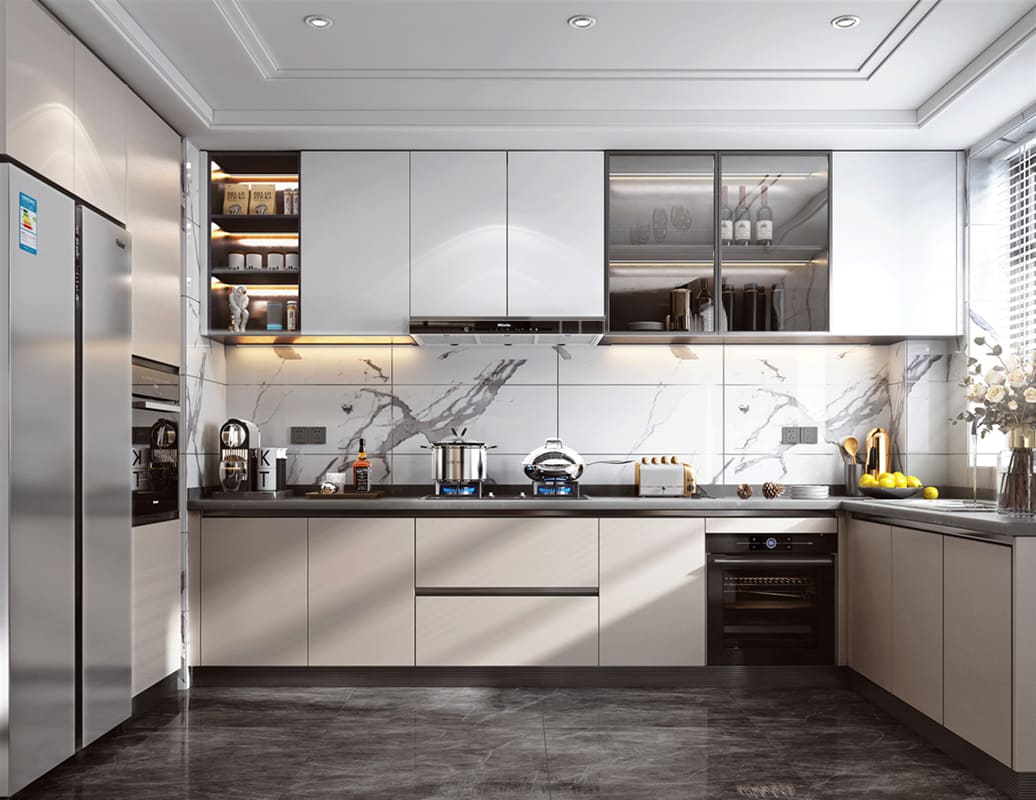
水泥灶台橱柜马来西亚 — 优缺点全解析(2026最新)
09/06/2026
PET 橱柜门板 vs 烤漆 vs 亚克力:马来西亚气候哪种最耐用?(2026)
09/06/2026Kitchen Cabinet for Condo Malaysia: Complete Guide 2026
Living in a Malaysian condo means your kitchen is probably the size of some people’s bathroom — and that’s exactly why choosing the right kitchen cabinet for condo Malaysia matters so much. When you’re working with 60 to 120 square feet, every cabinet decision either gives you breathing room or boxes you in. This guide walks you through the layouts that actually fit, materials that survive our humidity, realistic 2026 prices, and the renovation process most first-time condo owners learn the hard way.
You’re not alone in this. Thousands of condo owners in KLCC, Mont Kiara, PJ, and Subang face the same tight walls, the same management approval headaches, and the same fear of spending RM15,000 on cabinets that look great in a showroom but don’t fit their actual kitchen. By the end of this guide, you’ll know exactly what works, what doesn’t, and how to avoid the mistakes that cost other condo owners thousands.

Key Takeaways
– Most Malaysian condo kitchens range from 60–120 sq ft, which means layout choice is the single biggest factor in how your kitchen functions
– Plywood E0/E1 carcasses with PET or laminate doors offer the best balance of health, durability, and value for condo kitchens
– Condo kitchen cabinet prices in Malaysia range from RM6,000 (budget) to RM30,000+ (premium) for a typical small kitchen in 2026
– Management approval is mandatory before any renovation begins — skipping this can result in stop-work orders and forfeited deposits
– Smart storage accessories (pull-out organisers, corner carousels, vertical racks) can increase usable storage by 30–50% in small condo kitchens
Kitchen Cabinet for Condo Malaysia: Why Condo Kitchens Need Special Planning
A condo kitchen isn’t just a smaller version of a landed home kitchen. It operates under a completely different set of constraints — physical, regulatory, and practical. Skip this part and you’ll learn the expensive way — halfway through your reno, when changes cost the most.
Space Constraints (Most Condos: 60–120 Sq Ft Kitchen)
Let’s be real. The average condo kitchen in Malaysia — whether you’re in a studio in KL Sentral or a 3-bedroom in Ara Damansara — gives you somewhere between 60 and 120 square feet. That’s not a lot of room when you need to fit a stove, a sink, a fridge, storage for pots and pans, and still have counter space to prep a meal.
For context, a typical landed terrace house kitchen runs 140–200 sq ft. That extra 40–80 sq ft might not sound like much, but it’s the difference between a kitchen where you can comfortably cook for four and one where you’re doing a sideways shuffle between the stove and the fridge.
This means your cabinet layout can’t afford wasted space. Every corner, every wall, every inch above and below the counter needs to earn its keep. Standard off-the-shelf cabinets from a home improvement store simply don’t maximise these small footprints — which is why most condo owners end up with custom or semi-custom solutions.
[Image suggestion: Side-by-side comparison of a 80 sq ft condo kitchen vs. 160 sq ft landed kitchen, both with cabinets installed]
Management Rules & Renovation Guidelines
Here’s something no brochure tells you: your condo management has the final say on what you can and cannot do in your kitchen. Under the Strata Management Act 2013 (SMA), every building’s Joint Management Body (JMB) or Management Corporation (MC) sets renovation by-laws that you must follow.
What this means for your kitchen cabinets:
- Written approval is mandatory before any renovation work begins, including cabinet installation that involves hacking, plumbing changes, or electrical rewiring
- You’ll need to submit renovation drawings, contractor details, and sometimes even CIDB registration documents
- Most condos charge a renovation deposit of RM2,000 to RM5,000, refundable after a post-renovation inspection
- Noisy works (hacking, drilling) are restricted to approved hours — typically weekdays during office hours only
- Sunday and public holiday renovations are often prohibited entirely
This approval process can add 2 to 8 weeks to your timeline. Plan for it. Nothing derails a kitchen renovation faster than security turning your contractor away because the paperwork isn’t in order.
Not sure how to navigate your condo’s renovation rules? Get a free consultation with EverGreen → — they handle the measurement and design process with condo constraints in mind.
Structural Limitations (Can’t Hack Walls)
In a landed home, you can knock down a wall to open up the kitchen. In a condo? Not so much.
Load-bearing walls, beams, columns, and shear walls cannot be modified — period. Damaging structural elements compromises the entire building. Some condos even enforce a “300mm rule” that restricts drilling or hacking near concealed pipes and electrical conduits within walls.
Even non-structural walls aren’t a free-for-all. Removing a partition wall between your kitchen and living area may be allowed, but you still need management approval first. And moving major plumbing or drainage? That’s almost always off-limits because condo plumbing is vertically connected between floors — one badly modified pipe can cause ceiling leaks for your neighbours below, and you’ll be liable for their repairs.
The bottom line: your kitchen cabinet layout must work within the existing walls and plumbing points. This is why professional measurement and 3D design are non-negotiable for condo kitchens.
7 Condo Kitchen Cabinet Layouts That Actually Work
Your layout determines everything — how much storage you get, how efficiently you cook, and whether your kitchen feels cramped or comfortable. Here are seven layouts that fit Malaysian condos, from the tightest studio to the more spacious 3-bedroom unit.
[Image suggestion: Top-down layout diagrams of all 7 kitchen layouts side-by-side]
1. Single Wall (Galley) Layout
Best for: Studios and small 1-bedroom condos (60–80 sq ft kitchens)
Everything runs along one wall — stove, sink, fridge, and all storage. It’s the most space-efficient layout, but it also offers the least counter space and storage.
Tips to make it work:
- Use full-height cabinets (up to the ceiling) to maximise vertical storage
- Keep the fridge at one end and the sink at the other, with the stove in the middle — this creates a natural work triangle even on a single wall
- Add open shelving above the hood for items you use daily
Drawback: Very limited prep space. If you cook regularly, consider whether a single wall gives you enough room to comfortably work.
2. L-Shaped Layout
Best for: Most 2–3 bedroom condos (80–120 sq ft kitchens)
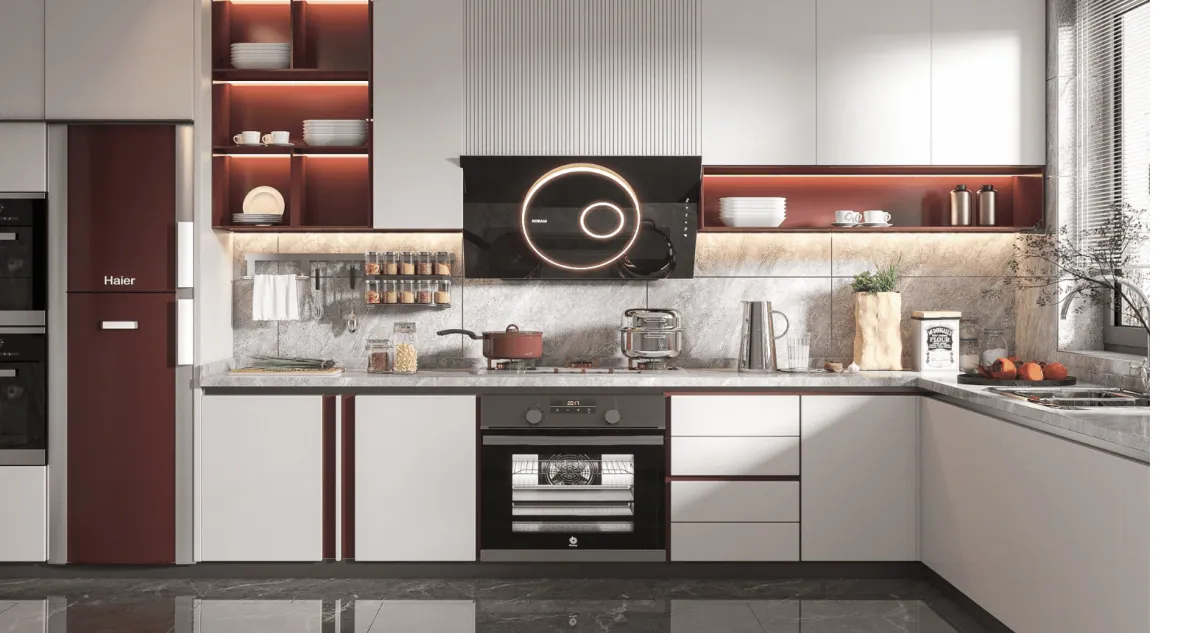
The L-shaped layout is probably the most popular condo kitchen design in Malaysia, and for good reason. Two walls of cabinets meet at a corner, giving you a natural work triangle and more counter space than a single wall.
Tips to make it work:
- Invest in a corner carousel or LeMans pull-out — L-shaped kitchens always have a corner that’s hard to reach, and a carousel turns dead space into usable storage
- Place the sink on one leg and the stove on the other to create an efficient workflow
- If your condo has an open kitchen concept, the L-shape naturally defines the kitchen zone without needing walls
3. U-Shaped Layout (If Space Allows)
Best for: Larger condos with wider kitchens (100–120+ sq ft)
Three walls of cabinets create a U-shape that offers the most storage and counter space per square foot. But it only works if your kitchen is wide enough to still have comfortable walking space in the centre.
Tips to make it work:
- You need at least 1 metre of clearance between opposite counters to move comfortably
- If the U-shape feels enclosed, consider removing the upper cabinets on one wall to open things up visually
- The two corners need corner solutions (carousels, pull-outs) — don’t leave them as unreachable dark holes
Drawback: Can feel enclosed in an already small space. Not suitable for narrow kitchens.
4. Parallel (Corridor) Layout
Best for: Narrow but longer kitchens (common in older condos and apartments)
Two walls of cabinets face each other with a walkway in between. This layout gives you excellent storage on both sides but requires careful spacing.
Tips to make it work:
- Keep the corridor at least 900mm wide — anything less and you’ll be squeezing past open cabinet doors
- Place the stove and sink on opposite walls for an efficient work triangle
- Use matching upper and lower cabinets on both sides for visual balance
5. Open Kitchen Concept
Best for: Small condos where the kitchen shares space with the living area
Many newer Malaysian condos — especially those in KLCC and Mont Kiara — come with an open kitchen that flows directly into the living room. Your cabinets need to look good from both sides.
Tips to make it work:
- Choose cabinet finishes that complement your living room furniture — your kitchen is now part of the living space
- A peninsula (cabinets extending from the wall) can define the kitchen zone and add extra counter space
- Invest in a good cooker hood — cooking smells travel fast in an open layout
- Consider PET doors — their sleek, modern finish looks intentional in an open-concept space
6. Peninsula/Island for Bigger Condos
Best for: Larger condo units (1,200+ sq ft) with spacious kitchens
If your condo has the room, a peninsula or small island adds prep space, casual seating, and extra storage. A peninsula is attached to the wall on one end, while a freestanding island sits in the centre.
Tips to make it work:
- You need at least 1 metre of clearance on all sides for comfortable movement
- A peninsula with open shelving on the living room side doubles as a room divider
- Keep the island depth at 600mm to avoid eating into your walking space
7. Corner-Maximising Layouts
Best for: Any condo kitchen where every inch counts
This isn’t a standalone layout but a principle you should apply to any of the above. Corner-maximising layouts use specialised hardware and clever design to turn dead corners into functional storage.
Key solutions:
- Magic Corner units — pull-out shelving that brings items from the back corner to you
- LeMans pull-outs — curved shelves that swing out of the corner cabinet
- Blind corner extenders — simpler pull-out trays for less budget
- Diagonal corner cabinets — cut the corner at 45 degrees for easier access
Ready to see which layout fits your condo? Get a free site measurement and 3D design → — EverGreen’s designers visit your unit and create a layout that works within your actual space and management guidelines.
Best Kitchen Cabinet Materials for Condo Malaysia: What Works Best
Choosing the right material is critical for condos. See our complete kitchen cabinet materials guide for detailed comparisons.
Malaysia’s humidity averages 70–90% year-round. Your kitchen generates steam, oil, and moisture daily. Choose the wrong material, and you’ll be replacing swollen doors and peeling edges within two years. Here’s what actually holds up.
Melamine (Budget-Friendly)
Melamine is a resin-impregnated paper that’s thermally fused to a particle board or MDF core. It’s the most affordable option and comes in a wide range of colours and wood-grain patterns.
Pros:
- Most affordable option — typically RM150–RM250 per foot run for the full cabinet
- Clean, modern appearance from a distance
- Wide variety of colours and textures
- Easy to wipe clean
Cons:
- Does not tolerate sustained water exposure — edges near the sink will start to swell and peel over time
- Not suitable for Malaysian wet kitchens where humidity, oil, and water are constant
- Lower durability rating compared to other materials
- Visible joins at edges can look cheap up close
Best for: Dry kitchens in condos with light cooking, rental units, or strict budget renovations under RM8,000.
Plywood E0/E1 (Health-Conscious Choice)
Plywood is made from thin layers of wood veneer glued together, making it significantly stronger and more moisture-resistant than MDF or particle board. It’s the structural backbone that determines how long your kitchen actually lasts.
The E0/E1 difference matters for your health:
- E1 plywood emits up to 0.1 ppm of formaldehyde — acceptable for commercial and well-ventilated spaces
- E0 plywood emits under 0.05 ppm — the safer choice for enclosed condo kitchens, especially if you have children at home
- E0 costs roughly 10–20% more than E1, but the lower off-gassing is worth it in a small, enclosed condo kitchen
Pros:
- Stronger and more stable than MDF or particle board
- Handles moisture significantly better — won’t swell like melamine or MDF
- E0-rated options minimise formaldehyde exposure in enclosed spaces
- The carcass material that determines your kitchen’s lifespan
Cons:
- More expensive than melamine or MDF alternatives
- Not a finish material — needs to be paired with laminate, PET, or acrylic doors
- E0 boards are harder to source from some suppliers
Best for: Long-term homes where durability and health matter. If you’re living in the condo (not renting it out), E0 plywood carcasses are the smartest investment.
PET Doors (Modern & Low Maintenance)
PET (Polyethylene Terephthalate) is a thermoplastic material applied as a foil over engineered board. It’s increasingly popular in Malaysian condos for its sleek appearance and practical benefits.
Pros:
- Scratch-resistant — handles daily wear far better than laminate or melamine
- Stain and moisture resistant — won’t swell or warp in Malaysia’s humidity
- UV resistant — won’t fade in sun-exposed condo kitchens with large windows
- Easy to clean with just mild soap and water
- Available in both high-gloss and matte finishes
- Recyclable and eco-friendly material
- Lightweight — puts less stress on hinges in upper cabinets
Cons:
- More expensive than laminate or melamine door options
- Matte PET shows fingerprints more easily than textured surfaces
- Limited warmth compared to solid wood aesthetics
- Fewer texture options than laminate
Best for: Condo owners who want a modern, low-maintenance kitchen that looks clean and holds up to daily use. Pairs perfectly with a plywood E0 carcass for the ideal health-meets-durability combo.
Aluminium (Termite-Proof but Limited Looks)
Aluminium cabinets use extruded aluminium frames with powder-coated panels. They’re virtually indestructible in Malaysia’s climate.
Pros:
- 100% termite-proof — no pest concerns at all
- Fully resistant to water, moisture, and humidity — zero swelling risk
- Heat-resistant — handles heavy Malaysian cooking without issue
- Lowest long-term maintenance of any material
- Designs have improved — darker powder-coated finishes and glass inserts address aesthetic concerns
Cons:
- Can feel “cold” or industrial compared to wood-based materials
- Most expensive mainstream option — RM500–RM900 per foot run
- Limited design warmth — harder to achieve a cosy or traditional look
- Fewer colour and texture options than laminate or PET
Best for: Wet kitchens, heavy daily cooking households, and anyone who prioritises zero-maintenance over aesthetic warmth.
Material Comparison Table
| Material | Price (RM/ft run) | Durability | Water Resistance | Termite Proof | Best For |
| Melamine | 150–250 | ★★★☆☆ | ★★☆☆☆ | ✗ | Budget, dry kitchens, rentals |
| Plywood + Laminate | 250–450 | ★★★★☆ | ★★★★☆ | ✗ | Long-term homes, best value |
| Plywood E0 + PET | 350–550 | ★★★★☆ | ★★★★☆ | ✗ | Health-conscious + modern look |
| Aluminium | 500–900 | ★★★★★ | ★★★★★ | ✓ | Wet kitchens, zero maintenance |
Our recommendation for most condo owners: Plywood E0/E1 carcass with PET doors. You get the health benefits of low-formaldehyde boards, the durability of plywood structure, and the modern low-maintenance look of PET — all at a mid-range price point.
Kitchen Cabinet for Condo Malaysia: Price Guide 2026
Let’s talk numbers. Knowing the price range before you start shopping prevents sticker shock and helps you spot quotes that are suspiciously low (they’re hiding something) or unreasonably high (you’re overpaying).
Price Ranges by Kitchen Size
Most Malaysian condo kitchens fall into the small kitchen category (60–90 sq ft) — check our small kitchen design guide, with some larger 3-bedroom units reaching the mid-range.
| Kitchen Size | Budget | Mid-Range | Premium |
| Small (60–90 sq ft) — Most condos | RM6,000–RM10,000 | RM10,000–RM18,000 | RM18,000–RM30,000+ |
| Mid (90–140 sq ft) — Larger condos | RM10,000–RM18,000 | RM18,000–RM35,000 | RM35,000–RM60,000+ |
What You Get at Each Price Point
Budget (RM6,000–RM10,000): Melamine carcass and doors, basic soft-close hinges, standard laminate countertop, minimal accessories. Functional but expect visible wear within 3–5 years.
Mid-Range (RM10,000–RM18,000): Plywood carcass (E1 or E0) with laminate or PET doors, soft-close included, quartz or solid surface countertop, some pull-out accessories. This is where most owner-occupied condos land.
Premium (RM18,000–RM30,000+): E0 plywood with PET or aluminium doors, premium hardware (Blum, Hettich), sintered stone or quartz countertop, full accessory package, integrated lighting.
Built-In vs Semi-Custom vs Custom
| Type | What It Means | Price Impact |
| Built-in | Pre-designed modular units fitted to your space | Lowest cost, but limited customisation |
| Semi-custom | Modular base with some custom modifications | Mid-range, balances cost and flexibility |
| Fully custom | Designed and built specifically for your kitchen | Highest cost, but maximises every inch |
For condos, semi-custom or fully custom is almost always the better choice. Pre-designed modular units rarely account for the uneven walls, awkward corners, and tight clearances that define condo kitchens.
Hidden Costs to Watch Out For
The quote you see is rarely the quote you pay. Here are the costs that catch condo owners off guard:
| Hidden Cost | Why It Adds Up | Typical Extra |
| Extra drawers | Drawers cost significantly more than doors | RM150–RM300 per drawer |
| Soft-close hardware | Often quoted with standard hinges by default | RM30–RM80 per hinge/pair |
| Corner pull-outs | Magic corners, LeMans trays priced separately | RM400–RM1,200 each |
| Countertop upgrade | Basic laminate is default; quartz/sintered stone is extra | RM1,500–RM5,000 |
| End panels & skirting | Finishing details often excluded from base quote | RM200–RM600 |
| Plumbing & electrical | Moving taps or adding power points for appliances | RM500–RM2,000 |
| Management deposit | Refundable but ties up cash | RM2,000–RM5,000 |
Budget rule of thumb: Always reserve a 10–15% contingency on top of your quoted price. Once old cabinets come down, surprises — uneven walls, hidden plumbing, structural quirks — are almost guaranteed in condo units.
Want a quote tailored to your actual kitchen dimensions? Request a free quotation from EverGreen → — they visit your condo, measure on-site, and give you an itemised breakdown with no hidden costs.
Condo Kitchen Renovation Process in Malaysia
Understanding the process before you start prevents the most common condo renovation disaster: running out of money halfway through because you didn’t plan for the timeline, approvals, and coordination that condo kitchens demand.
Getting Management Approval
This is step one. Not step two. Not “after you’ve picked your tiles.” Step one.
The process typically looks like this:
- Request your condo’s latest renovation guideline from management — rules vary by building, so don’t rely on what your neighbour told you
- Prepare required documents — owner IC (name spelling must match exactly), unit details, scope of work description, contractor license and contact details
- Submit application forms with renovation drawings and contractor documents
- Book lift slots for material delivery — yes, you need to reserve the service lift in advance
- Pay renovation deposit (RM2,000–RM5,000) — only after you receive written approval
- Share approval confirmation with both your contractor and security — this ensures smooth entry on day one
Common reasons for rejection: Missing contractor documents, unclear scope of work, no lift protection plan, start dates during blackout periods, and incomplete forms.
Timeline: Allow 2–8 weeks from submission to approval. Don’t book your contractor for firm dates before written approval arrives.
Ameera, a first-time condo owner in Petaling Jaya, learned this the hard way. She booked her contractor for a Monday start, but her management took three weeks to approve the renovation. The contractor moved on to another project, and she waited another month for an opening. “I lost almost two months just on paperwork,” she says. “If I’d submitted the forms before I even chose my cabinets, I’d be cooking in my new kitchen by now.”
Timeline Expectations
Here’s a realistic timeline for a condo kitchen cabinet renovation in 2026:
| Phase | Duration | Notes |
| Management approval | 2–8 weeks | Varies widely by condo |
| Design & quotation | 1–2 weeks | After on-site measurement |
| Cabinet production | 3–6 weeks | Custom cabinets are made to order |
| Delivery & installation | 3–5 days | Restricted to approved working hours |
| Countertop fabrication | 1–2 weeks | Template taken after cabinets are installed |
| Final touches & cleanup | 1–2 days | Silicone, adjustments, debris removal |
| Total realistic timeline | 8–18 weeks | From approval to finished kitchen |
The biggest factor? Management approval time varies wildly. A well-run MC in a newer Mont Kiara condo might approve in two weeks. An older building with a slow JMB could take two months.
Working with an ID vs Direct Contractor
| Approach | Pros | Cons |
| Interior Designer (ID) | Single point of contact, cohesive design, handles contractor coordination | Higher total cost (10–20% markup), may push premium materials |
| Direct cabinet maker | Lower cost, direct communication with the builder, more control over materials | You coordinate everything yourself, no design guidance, more project management burden |
For first-time condo owners, working with a cabinet specialist who offers end-to-end service (measurement, design, production, installation) often gives you the best balance of cost and convenience — you’re not paying ID markup, but you’re also not managing the project alone.
10 Small Kitchen Storage Hacks for Malaysian Condos
When your kitchen is 80 square feet, storage isn’t a nice-to-have — it’s the difference between a kitchen that works and one that drives you to your limit. Looking for small kitchen cabinet ideas Malaysia homeowners actually use? These ten hacks are proven to maximise usable storage in small Malaysian condo kitchens — and similar principles apply to HDB condo kitchen cabinet layouts and any kitchen cabinet for small space Malaysia setups.
1. Pull-Out Organisers
Base cabinets with fixed shelves waste up to 40% of their depth because you can’t reach items at the back. Pull-out organisers on full-extension runners bring everything to you.
What to install:
- Pull-out pantry units (150mm–300mm wide) for spices, oils, and sauces
- Pull-out baskets for pots, pans, and containers
- Pull-out bins under the sink for waste sorting
2. Corner Carousels
If your layout includes a corner cabinet (and most L-shaped and U-shaped kitchens do), a corner carousel is non-negotiable. These rotating shelves bring items from the deep back corner to you.
- Half-carousel — fits a standard 900mm corner cabinet
- Full carousel — for larger corners
- Budget alternative: Lazy Susan inserts sit on existing shelves
3. Vertical Storage
Think up, not out. Full-height cabinets that go all the way to the ceiling give you 30–50% more storage than standard upper cabinets that stop 300mm below the ceiling.
- Use the top shelves for items you rarely use (holiday serveware, bulk supplies)
- Add pull-down shelving rods if reaching the top is difficult
- Consider tall pantry cabinets (300mm wide, full height) for dry goods
4. Over-Cabinet Racks
The space above your upper cabinets is probably empty. A simple over-cabinet rack slides over the top of the door and gives you instant storage for cutting boards, aluminium foil, and lightweight items.
- No drilling required — they simply hook over the cabinet door
- Great for items you use daily but don’t want cluttering the counter
- Available from RM15–RM40 online
5. Drawer Dividers
A drawer without dividers is a jumbled mess within a week. Custom drawer dividers keep cutlery, utensils, and small items organised and accessible.
- Modular dividers can be reconfigured as your needs change
- Deep drawers with dividers replace multiple shallow ones
- Knife blocks that fit inside a drawer are safer than countertop blocks
6. Door-Mounted Storage
The inside of cabinet doors is wasted space in most kitchens. Mount racks, hooks, or slim shelves on the inside of cabinet doors for:
- Spice racks (inside upper cabinet doors near the stove)
- Lid organisers (inside lower cabinet doors)
- Cutting board holders
- Measuring cup and spoon hooks
7. Under-Sink Organisers
The space under the sink is awkward because of the plumbing. But with the right organiser, it becomes valuable storage for cleaning supplies and bin systems.
- U-shaped pull-out shelves that fit around the plumbing pipe
- Tension rods for hanging spray bottles
- Slim tiered racks for sponges and dish soap
8. Magnetic Strips & Wall Rails
When counter space is at a premium, move items to the walls:
- Magnetic knife strips — free up drawer space and keep knives accessible
- Slat wall rails — hang utensils, paper towels, and small shelves
- Hook rails — for mugs, ladles, and cooking tools
This is a common feature in Japanese-style small kitchens — and it works beautifully in Malaysian condos.
9. Appliance Garage
A dedicated cabinet with a pocket or tambour door that hides your toaster, kettle, and coffee machine when not in use. The appliances stay plugged in and ready — you just close the door to clear the counter.
- Needs a dedicated power point inside the cabinet
- Minimum 400mm depth to fit most appliances
- Especially useful in open-concept kitchens where counter clutter is visible from the living area
10. Toe-Kick Drawers
The space under your base cabinets (the toe kick) is typically 100mm of dead air. Toe-kick drawers convert this into shallow storage for flat items like baking sheets, placemats, and cutting boards.
- Adds storage without taking any additional floor space
- Best planned during initial cabinet design — retrofitting is difficult
- Particularly useful in the narrowest layouts where every centimetre counts
Common Condo Kitchen Renovation Mistakes to Avoid
These are the mistakes that cost Malaysian condo owners real money. Learn from others’ experience rather than your own wallet.
1. Skipping Management Approval
It’s tempting to just start, especially if your renovation is “minor.” But even installing new cabinets that require drilling or plumbing changes typically requires at least a renovation registration with your management. Skipping approval can result in stop-work orders, forfeited deposits, and fines.
2. Choosing the Cheapest Quote
If a quote is 20% lower than the others, something is missing. The most common exclusions: soft-close hardware, proper wet zone protection, quality carcass materials, and debris disposal. These “hidden” costs add up to more than you saved, and you’ll notice the quality difference within 2–3 years.
3. Not Getting an Itemised Quote
A lump-sum quote gives you zero leverage when something goes wrong. Demand an itemised quotation with line items for materials, labour, hardware, accessories, and finishing. This is how you compare quotes fairly and hold contractors accountable.
4. Paying Too Much Upfront
Never pay 70–80% before work begins. A reasonable payment schedule looks like:
- 10% booking
- 20–30% on material arrival
- Milestone-based payments for completed work
- Final 10–15% after installation and defect checks
5. Ignoring Appliance Dimensions
This sounds obvious, but it happens constantly. You buy a 600mm oven only to find that your cabinet niche is 585mm because the installer didn’t account for tile thickness and adhesive buildup. Always confirm appliance model codes and dimensions before cabinets are built, and add at least 5mm of breathing room on each side.
6. No Contingency Budget
In condo renovations, hidden issues surface once old cabinets come down — uneven walls, concealed pipes, wiring that needs upgrading. Without a 10–15% contingency buffer, these surprises stall your project or force you to cut corners on finishing.
7. Forgetting About Delivery Access
You ordered a full-height pantry cabinet. Great. But does it fit in your condo’s lift? Can it navigate the hallway from the lift to your unit? Measure the lift interior, hallway width, and unit door width before ordering any cabinet taller than 2.1 metres. Many condos have service lifts with restrictive dimensions.
Why EverGreen Custom Cabinets for Your Condo
Look, by now you get it: condo kitchen cabinets aren’t something you can just pick from a catalogue and hope for the best. You need a partner who understands the constraints — the tight spaces, the management rules, the humidity, the need for materials that don’t off-gas in enclosed rooms.
EverGreen Custom Cabinets specialises in exactly this kind of challenge. Here’s what sets them apart for Malaysian condo owners:
- E0/E1 plywood carcasses — the health-conscious choice for enclosed condo kitchens, especially important if you have young children at home. Lower formaldehyde emissions mean safer indoor air quality
- PET door options — modern, scratch-resistant, and moisture-proof finishes that look sleek and hold up to daily Malaysian cooking
- Free site measurement — they come to your condo unit and take precise measurements, accounting for those uneven walls and tight clearances that define condo kitchens
- Free 2D and 3D design — see your kitchen layout before committing, with designs that work within your management’s renovation guidelines
- End-to-end service — from quotation through production, installation, and after-sales support. One point of contact, no coordination headaches
- Eco-friendly materials — EverGreen uses sustainable board options including Daintree and Kronospan, aligning with their philosophy of “cabinets built to last, with nature in mind”
- Experience with Malaysian condos — they understand the management approval process, lift access constraints, and restricted working hours that come with high-rise renovation projects
Ready to get started?
📞 Call/WhatsApp: 011-6941 1186
📧 Email: enquiry@evergreencustomcabinets.com.my
🌐 Book a free consultation: evergreencustomcabinets.com.my/contact
Conclusion
It boils down to this: get the layout right, pick materials built for this climate, and don’t skip the paperwork.
Get the layout right, and even a 70 sq ft kitchen can feel functional. Choose materials built for Malaysia’s humidity — E0/E1 plywood carcasses with PET or laminate doors — and your cabinets will last a decade instead of disintegrating in two years. Follow the renovation process properly, from management approval to installation, and you’ll avoid the mistakes that cost other condo owners thousands in delays and rework.
The best kitchen cabinet for condo Malaysia isn’t the cheapest one, or the one that looks best in a showroom. It’s the one designed for your actual space, built with materials that survive our climate, and installed by a team that understands condo renovation rules.
Your next step: Get a professional on-site measurement. It’s free, it takes an hour, and it’s the single most important thing you can do before spending a single ringgit on cabinets. Book your free measurement with EverGreen →
Your condo kitchen might be small. But with the right cabinets, it can be exactly what you need it to be.
Frequently Asked Questions: Condo Kitchen Cabinets in Malaysia
How much does a condo kitchen cabinet cost in Malaysia?
Condo kitchen cabinet prices in Malaysia range from RM6,000 for a budget small kitchen (melamine, basic hardware) to RM30,000+ for premium materials (E0 plywood + PET doors, quartz countertop). Most owner-occupied condos spend RM10,000–RM18,000.
Do I need management approval for condo kitchen renovation?
Yes. Under the Strata Management Act 2013, written approval from your JMB/MC is mandatory before any renovation work begins. Skipping this can result in stop-work orders and forfeited deposits. Allow 2–8 weeks for approval.
What is the best material for condo kitchen cabinets in Malaysia?
E0/E1 plywood carcass with PET or laminate doors offers the best balance of health, durability, and value for Malaysian condo kitchens. Plywood handles humidity far better than MDF or particle board, and E0-rated options minimise formaldehyde in enclosed spaces.
How long does condo kitchen renovation take?
A realistic timeline is 8–18 weeks from management approval to finished kitchen: 2–8 weeks approval + 1–2 weeks design + 3–6 weeks production + 1–2 weeks installation and countertop fabrication.
Can I hack walls in my condo kitchen?
Generally no. Load-bearing walls, beams, and structural elements cannot be modified in condos. Even removing non-structural partition walls requires management approval. Moving major plumbing is almost always prohibited because condo plumbing is vertically connected between floors.